Aldi aims for middle England with Christmas ads

Aldi is launching a Christmas ad campaign with a view to show people they are able to get everything they want for the festive season at its stores and don’t need to shop around.

aldi-xmas-2013-460

Debuting on TV today (4 November) and available on its Facebook page already, the ads build on Aldi’s “Like Brands Only Cheaper” strapline. They’re going to feature a number its own brand products including smoked salmon, mince pies and poo.

Aldi says: “We know consumers want the appropriate tasting products at Christmas, but that the charges soon mount up. Our ‘Like’ adverts are designed with this in mind and show people they may be able to cut the price of Christmas at Aldi, while not having to chop the celebrations.”

The campaign launches as figures from Verdict show that increasingly more consumers are doing their full grocery shop at Aldi, up from 2.9 per cent a year ago to 4.4 per cent now. Of these that switched, 36.6 per cent came from Tesco, 19.7 per cent from Asda, 16.9 per cent from Morrisons and 12.7 per cent from Sainsbury’s. 

A fifth of these that use Aldi are middle or upper middle class, in step with Verdict, proving the expansion in appeal among midmarket shoppers searching for a bargain.

Andrew Stevens, food and grocery specialist at Verdict, says that much of Aldi’s growth have been all the way down to some “very clever” marketing. He describes the “Like Brands Only Cheaper” strapline as simple and effective in communicating to customers what the supermarket chain stands for.

“Rival supermarkets are shouting and squabbling over who’s cheaper. Aldi has both a worth and quality message that folk understand and might relate to,” he adds.

Rival discount chain Lidl can also be promoting its premium own brand products with the launch of its first nationwide TV campaign. Tesco and Sainsbury’s are both set to unveil their Christmas ads within the coming week.

Co-op insists it can be still ‘UK’s leading ethical bank’

The Co-operative has launched a campaign insisting it’s still the “UK’s leading ethical bank” despite it being 70 per cent owned by a set of personal investors.

coop-ad-2013-460

Press ads seek to reassure customers rescue deal cannot change ethical stance.

The group has today (4 November) detailed a rescue plan for its banking division designed to plug a £1.5bn hole in its finances.

As component of the plan, the Co-operative group will invest £462m inside the bank and become the unit’s largest shareholder with a 30 per cent stake. However, creditors, including several hedge funds, will own 70 per cent of the bank and invest £1.06bn.

The Co-operative Bank’s advertising has focussed as much on its ethical lending and investment practices because it has on its services and products. Its customer base swelled within the wake of the financial crisis as customers searched for alternatives to the large high street banks.

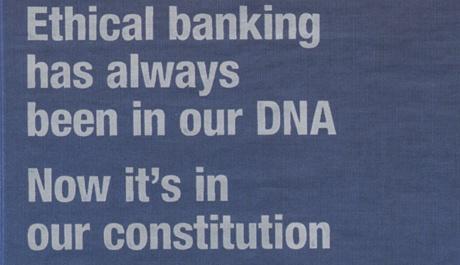
The bank has taken out full-page advertisements in today’s newspapers with the headline “Ethical banking has always been in our DNA, now it’s in our constitution” a connection with the “legally binding” addition of a moral code of conduct to the bank’s constitution.

Euan Sutherland, group chief executive of The Co-operative Group, says the crowd will continue to have a “significant influence” at the bank’s direction.

“We have enshrined the values and ethics that lie on the heart of The Co-operative Group into the hot rules that govern the bank.

“We have hooked up a values and ethics committee which will be chaired by a senior independent director. The bank would be what its customers expect of it – an even, responsible and trusted bank that delivers great service to retail and small business customers, underpinned by the values and ethics of the Co-operative movement.”

In an extra move to reassure customers it has not abandoned its proposition, the bank may also canvas them on social media and via unsolicited mail early next year  “on what our ethical policy commits us to”.

Meanwhile, the bank has also announced it’s going to reduce the scale of its branch network by about 15 per cent, which might see about 50 branches close. Sutherland told the BBC it should “significantly enhance” its online banking operation in this case.

The group’s perilous financial position derives from debts incurred because of the merger with the Britannia Building Society in 2009 and the price of compensating customers mis-sold payment protection insurance.

The rescue deal is a renegotiation of the complex “bail-in” process announced in June. 

Ryanair issues second profit warning because it continues customer support overhaul

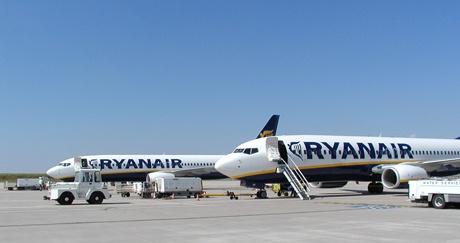
Ryanair has warned that its profit is ready to fall for the primary time in five years because it continues to overtake its customer support in a bid to enhance the brand’s image.

ryanair

The airline says that increased competition within the European market will push average fares down by around 10 per cent over the winter. That has caused Ryanair to chop its profit forecast for the second one time in two months for the year to March from €570m to €510m, below the €569m it made last year.

The figures come because the airline aims to enhance its reputation for poor customer support. It has announced quite a few updates including a cut in baggage fees, a redesigned website geared toward making it easier to book tickets and a “My Ryanair” member service.

The latest change will see Ryanair shift to totally allocated seating on its flights. Customers that desire to reserve “popular” seats, along with those inside the front row, might be ready to pay €5 to take action, so long as they check-in additional than 24 hours before departure.

Ryanair says: “Our decision to launch fully allocated seating is a part of the airline’s commitment to hear its customers and improve its industry leading customer support.”

Ryanair faced growing criticism from both customers and shareholders over its poor customer support. While previously this didn’t worry the firm as a result of its strong growth, increased competition, both profit warnings and a prediction that there’ll be a “pause” in traffic growth over the subsequent 365 days means it now must improve brand perceptions.

Ryanair currently languishes on the bottom of virtually every metric on YouGov’s BrandIndex, from reputation and satisfaction through to impression and quality. It also came in last through which?’s customer support survey, performing the worst out of the UK’s 100 biggest brands.

The customer support changes tend to affect Ryanair’s final analysis as ancillary revenues from baggage fees and boarding pass re-issue penalties are significant for Ryanair. However, the firm says these don’t have an important impact on its current fiscal year.

For the 1st 1/2 the year, Ryanair’s profit hit a record €602m as a 2 per cent fall in average fare price was offset by a 22 per cent rise in extra charges. Traffic was up 2 per cent to 49 million passengers.

Lynx preps £9m ‘Peace’ sub-brand unveil to kickstart sales

Unilever is pouring £9m into the selling for its latest Lynx Peace variant to make it the focus for the logo in 2014 in an breathe life into flagging sales.

LynxPeace-Product-2013_460

The male grooming range goes on sale later this month and should be supported by TV, outdoor, digital, print, sampling, radio and in-store activity. The nationwide campaign will promote the product’s “woody fragrance” and target men in search of a more “sophisticated” and “edgy” offering.

Mark Aschmann, Lynx brand manager at Unilever, says the launch aims to achieve a much broader audience. The launch comes because the festive season kicks in and the business is banking on seasonal demand to offer it momentum going into the hot Year.

Aschmann: “Following on from the hugely successful launch of Lynx Apollo last year, Lynx Peace shall be our main focus in 2014.”

It follows the launch of Lynx Apollo in 2012, which despite generating online buzz around its advertising campaign to send fans into space, has did not lift sales of the final brand. Lynx sales fell 2.4 per cent year-on-year inside the UK to £167m for the 52 weeks to 7 September, consistent with IRI Worldwide.

During this time, the logo has ramped up its “always-on” digital strategy in an try to broaden its reach. It became one of the vital first advertisers within the UK to check Snapchat – a mobile app that permits users to send photo messages that self-destruct after a period of 10 seconds or less – this summer, claiming it desired to deliver “compelling” content to fans.

Brand Audit: Ryanair

Ryanair is infamous for its poor customer support, but with autumn passenger numbers falling and the airline issuing its first profit warning for 10 years, it’s now seeking to dispose of its image because the nasty airline. 

ryanair

Ryanair achieved rapid growth by providing cheap flights with zero frills to a big range of short-haul destinations. While that wbecause the case it almost revelled in its position as the most hated airline, with CEO Michael O’Leary offering withering putdowns to anyone who dared complain.

He has memorably labelled customers “idiots”, called people who forget to print their boarding pass “stupid” and told anyone in search of a reimbursement to “**** off”. Yet now he has performed a u-turn, embarking on a charm offensive geared toward improving negative perceptions and addressing its reputation for poor customer support.

Simon Carter, previously executive marketing director at Thomas Cook UK and Ireland and now marketing director at Fujitsu, says: “Ryanair has always been the enigma in the case of customer support. Despite the logo being the underside of most customer satisfaction tables and being the primary name that the majority people cite when talking about brands they like to hate, O’Leary has grown his business.

“It is therefore interesting that Ryanair has finally concluded that the textbooks were right, that buyers do have a decision and that customer respect is important.”

What changed?

Ryanair have been hit by attempts by low-cost rivals, including EasyJet and Monarch, to enhance service. Increased competition and weakening demand for air travel also caused Ryanair to chop its fares this year, entering a worth war with its rivals. That’s impacting on margins, with Ryanair issuing a profit warning for the fist time in 10 years.

Douglas McNeill, investment director at Charles Stanley Direct, says: “Ryanair has seen some decrease in financial returns. The onus is on it to answer that.”

That has ended in a raft of improvements, including cutting airport fees, offering a “grace” period on bookings and easing bag curbs. It is usually overhauling its digital strategy, investing more in mobile and social media, and hiring its first marketing director.

These are usually not just cosmetic changes. Ancillary revenues from baggage fees and boarding pass re-issue penalties are huge for Ryanair and these changes will affect its base line.

Philip Price, formerly marketing director at P&O Cruises and now consultant and client services director at Leepeckgoup, says: “These changes will directly reduce revenues by millions. But O’Leary has not suddenly had a road to Damascus revelation, he has realised that buyers are worth keeping and that it’s far rather more effective to take a position in CRM, in both its operational and marketing senses, than to move find new customers.”

The Ryanair Brand

Ryanair languishes on the bottom of just about every metric on YouGov’s BrandIndex, from reputation to satisfaction, through to impression and quality.

Since September 19, the day before its first announcement in regards to the measures it’s taking to enhance service, its Reputation rating has increased from -53.1 to -52.7 on 31 October. Impression of the emblem improved from -51.6 to -50.3 and Quality is up by 2.6 points to -50.3.

However, it’s still miles behind its rivals. The subsequent worst performing airline for Reputation and Quality is EasyJet on -17.2 and -14.7 respectively, while Turkish Airlines is available in second bottom for Impression with a score of 0.3.

There are signs that consumers are paying attention to its attempts to enhance perceptions. Buzz, a measure of whether people have heard positive or negative statements a few brand, is up from -29.8 to -23.2, a statistically significant improvement.

Meanwhile Ryanair’s Index score – BrandIndex’s average of all perception measures including impression, quality, value, reputation, satisfaction and recommendation – rose from -41 to -36.9.

McNeill says despite Ryanair’s poor reputation, it’s still an incredibly strong company and an incredibly profitable business. Plus it has enough expertise and savvy to perform what it has got down to do.

It may take a little time, with the type of cultural changes had to buy into this shift in any respect levels of the organisation unattainable in brief order. There must be changes in how staff are trained and the way they reply to customer.

While customer support remains a chink in its armour and not to make improvements quickly could impact the airline financially. Having announced its intentions, it must now make certain it delivers.

Groupon celebrates 5th birthday with redesign

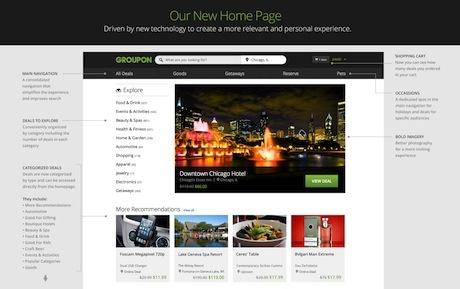
Groupon is marking its fifth anniversary with a redesign of its website and mobile apps its says better reflects the way it has shifted from being a regular deals email service to “a true online marketplace”.

Groupon home page

The redesigned Groupon now includes a personalised homepage, which curates deals in response to users’ previous purchases, interests and purchases by other customers with similar interests.

It has also enhanced its search feature, with a search bar appearing on the top of each page, cross-channel results and more “robust” filters.

On mobile, a brand new feature have been introduced called “local explorer” which automatically detects when a user’s location has changed and serves deals in response to the present city they’re in.

Groupon CEO Eric Lefkofsky says: “Our new site and mobile app makes it easier and more rewarding for patrons to study Groupon first when why desire to buy absolutely anything, anytime, anywhere.”

Groupon reported a 7 per cent year on year increase in revenue to $608.7m within the quarter to 30 June. A 24 per cent decline in EMEA revenue and a 26 per cent decline in revenue from the remainder of the area offset 45 per cent growth within the US. Operating profit dropped 41 per cent to $27.4m within the quarter.

Looking forward, Groupon said continued investments in marketing would drive long-term growth in its third quarter.

Groupon’s transformation to becoming more of a marketplace kickstarted early this year when it hit the headlines for posting a surprise quarterly loss, sending shares down 28 per cent and prompting the dismissal of its quirky co-founder Andrew Mason. 

In August Lefkofsky was appointed as CEO and has focused Groupon’s turnaround around three pillars: mobile, marketplace and bringing the performance of its non-US regions consistent with its home market.